
Getting Along with Mr. Big
Author: Marty Snyderman
While working as a cinematographer on a film about Mexico’s Sea of Cortez in the early 1980s, I was documenting the behavior of two bull California sea lions as they reaffirmed the exact location of the line separating their respective territories. There was not a physical line I could see, but the line real to the bulls.
I was only in about 10 feet of water and had been filming the pair for over an hour. One bull would be near the line when the other more distant animal would start to bark and bark as it approached. The bull near the line would retreat and the “barker” would settle close to the line. A few minutes later the two bulls would reverse roles. There were a few very brief physical clashes, as it was mostly a case of taking turns barking, approaching, and retreating.
It was August and the territorial disputes had mostly been settled months earlier. But on that day, things were different. I still don’t know why. Suddenly, one of the bull sea lions swam right at me. In the blink of an eye, it maneuvered around my camera and had my left forearm in its mouth. The bull shook me, much more gently than it could have, and then it let go and swam away.

For me, the moment was life-changing. I could have been seriously injured. If we get three wishes in life, I was down to two. Maybe, I used all three.
No doubt about it, I was extremely fortunate. There is no question that I put myself in a potentially dangerous situation. I did that. No one else. Not the sea lion. Not the film’s Producer. I am responsible for myself, and I allowed myself to be in that position.

A California sea lion bull has a huge head, mouthful of big teeth, and a powerful bite. A fully grown male can weigh as much as 1,000 pounds or more.
This dive occurred relatively early in my career as an underwater filmmaker and photographer. Over the years, I have thought a lot about how and why I allowed myself to get into a position in which I could have been seriously injured and how to avoid similar scenarios while continuing to dive and work around Mr. Big- sea lions, seals, sharks, whales, dolphins, manta rays, billfishes, or whoever that might be.
Let Me Be Clear
In the days since my encounter with the bull sea lion, I have seen many species of whales, dolphins, sharks, billfishes, manta rays, sea lions, seals etc. while looking through my viewfinders. Those scenes include these images of a shortfin mako shark and the eye of a southern right whale.


I am not about to say that you can’t do the same. Instead, what I hope to do with the thoughts and experiences I share is help you enjoy photographic success without putting yourself in harm’s way while photographing Mr. Big. Frankly, this is a piece I have thought about writing for years. But fearing I would come off as a “self-proclaimed know it all”, so I avoided writing the article.
So, why now? Well, last weekend for what seems like the gazillionth time, at a cocktail party at the Scuba Show in Long Beach, California I heard an accomplished photographer go on and on about how “sharks are like puppy dogs”. Maybe he knows something I don’t. Maybe a little alcohol and the setting encouraged him to speak in hyperbole. But whatever the case, I decided it was time.
I’ll start by saying that in my opinion big wild animals are exactly that. They are big and wild. No one knows exactly what a shark, whale, billfish, manta ray etc. will do every time in in every situation. I think we are better served to think that what Mr. and Ms. Big want to do is eat, perhaps socialize with other of their species, perhaps court and mate, in some cases take care of their young, rest, and be left alone. In some cases, divers are largely ignored. In other instances, we become objects of curiosity. In still others, large marine animals do not appear to approve of our presence and that possibility should always be in the forefront of our minds when we are trying to photograph Mr. Big.
I want to avoid sounding like the advertisements for “Shark Week” when I am referring to Mr. Big. Conversely, I don’t want to sound like Pollyanna. In my career, I have learned a lot while working with numerous scientists and other specialists whose careers have revolved around learning about various species. Their knowledge and input has been invaluable.
Yet, I have been with several people who were bitten by sharks, rammed by a whale, bitten by sea lions, badly scraped by an encounter with a manta ray, and bitten by a barracuda. Denying those incidents would not be truthful. In some cases, but certainly not all, bait was being used and that can change how one interprets these events. But bait was not used in every case.
I will also say my image library holds several thousand photographs of sharks, whales, dolphins, sea lions, seals, billfishes, and manta rays etc., like the great white shark, and manta ray pictured here.


I am a firm believer that if I can acquire those photographs, so can you. I don’t think I am special, but I do think my experiences help me consider various possibilities and I am far more thoughtful about various possibilities than I once was. I hope my words and images encourage you to think in realistic terms and consider how you will want to respond in various “what if this or that happens” scenarios when working with Mr. Big. I also hope you get the most out of your encounters and enjoy photographic success.
Making the Photographs You Hope to Create
No doubt about it, it is easier to make compelling images of Mr. Big in clear, shallow water on sunny days than it is in deeper areas. The sun can light Mr. Big in a pleasing manner if you use that light to your advantage as I was able to do when making this photograph of an oceanic whitetip shark in Hawaii.


While you cannot control exactly where an animal will be, there are times when you can control where you will be in relation to your desired subject. Experience has taught me that when working in shallow water on sunny days, you will probably be able to make more compelling photographs if you compose images with the sun at your back or over your shoulder as was the case when making this photograph of a whale shark.
By contrast, shooting into sun often causes the head, face, or mouth of an approaching animal to be dark while also losing color, detail, and visual appeal as happened with this image of a whale shark.

The takeaway message is to keep your position relative to the position of the sun and your subject in mind so you can take advantage of directional light from the sun.
Making the Photographs You Hope to Create
Exactly how to get as close to Mr. Big as needed to compose a compelling frame and shoot through as little water as safely possible varies significantly from species to species, individual animal to individual animal, the presence or absence of bait or food, the sex of your subject, time of year, the setting etc. Some factors to keep in mind follow.
In the excitement of the moment, it is natural that many photographers swim as fast as they can toward their subject in the effort to have Mr. Big fill a pleasing percentage of their frame and to shoot through as little water as possible. But there is often a price to pay for charging ahead. Despite their size, big animals can be wary of the unfamiliar. Swimming directly at animals, even those that are many times larger than humans, often causes them to turn away or go deeper. Either scenario makes creating compelling photographs far less likely.
Remaining relatively still and having good buoyancy control while allowing Mr. Big to approach you helps create more productive encounters in many instances.

A basking shark as seen in the waters near Scotland’s Isle of Mull
If Mr. or Ms. Big dives deeper, lighting becomes more difficult as the potential benefit provided by sunlight in shallow water diminishes with depth. In addition, your subject will be more likely to blend in with its surroundings. Making an impactful photograph will require strobe light to create separation between your subject and its surroundings. Creating that separation necessitates being close to your subject. With larger animals that can easily outswim divers, getting as close as necessary to a descending animal can be very hard to do.
I am not suggesting that you never swim toward Mr. Big, but I am suggesting you avoid being overly aggressive in your effort to get closer. When swimming toward my subject, I can often get closer if I move slightly to one side of my subject as opposed to taking a “head on” angle.
Swim to Where Mr. Big Is Going Not to Where He Is

In the case of filter feeding species such as whale sharks, basking sharks, manta rays, and others, when they are feeding you will probably enjoy better photographic opportunities by positioning yourself where their food source (a concentration of plankton) is.
Swim toward a highly mobile, filter feeder and it is likely that you will find yourself where your subject was while looking at its tail as opposed to where he is or where he is going.


Large filter feeding animals are routinely described as being docile. The word often sounds appropriate. But keep in mind, they are big and can be extremely powerful. Male humpback whales sometimes demonstrate their power by violently “slapping” their tail on the surface.
I have been in the water when a California gray whale “threw its tail” at a nearby diver. The result was several broken ribs and a near loss of consciousness. I also watched a southern right whale lift a diver wearing a drysuit and full scuba gear out of the water and roughly “toss” him a few feet away. It was a “heart in my throat” kind of moment for the diver and for me as a witness.
Yet, I would eagerly go try to photograph a whale tomorrow. But I would avoid getting immediately behind its tail. Based on my personal experience, whales don’t like other creatures to be “on their six”. I have seen a lot of whales with bite marks on their flukes, so it makes sense to me that a whale might not be comfortable with a diver close to its tail.
In another scenario, one should also be cautious when working with a mother whale accompanied by a calf.

You will want to avoid getting so close to the calf that the mother decides to take protective action. There are risks to such an encounter, despite the fact that public perception and bar talk is that whales are docile and “friendly”. I suggest keeping the same considerations in mind when trying to photograph whales during their mating season.
Shark & Bait
It is inevitable that sharks and the use of bait would have a place in this discussion. Using bait to attract any wildlife is a controversial topic. I am going to avoid the philosophical aspect, while acknowledging that bait is used on a variety of “shark dives” around the globe.
Worldwide, there are more than 530 species of sharks. With many species the use of bait can significantly change their behavior. In my experience, with species that do respond to bait such as blue, gray reef, tiger, lemon, silky, great hammerhead, shortfin mako, bluntnose sixgill, Caribbean reef etc., the sharks tend to swim “up the cone of the chum line” that is produced by current spreading the bait. This means the sharks approach the bait from down current. Knowing where your desired subject will be coming from as it approaches bait allows you to establish exposure-related camera settings before your subject arrives. This can be a valuable, time-saving photographic strategy as all you need to do is compose, focus, and shoot as many frames as seems appropriate when your subject closes in.

A baited great hammerhead shark as seen in the waters off Bimini
Yet, there is no question that different species of sharks behave differently. Even the same animal will sometimes respond in a vastly different way on a different day or even within seconds. Beware, not all sharks always swim up a chum line even when one is present. Many times, I have seen a great white shark repeatedly swim up a chum line before turning away, disappearing, and reappear while swimming from the opposite direction on its next approach.

Changing their approach can be a good strategy for a predator, but it can make complacent photographers who are hanging out of a shark cage or swimming in the open exposed and vulnerable.
The takeaway message is don’t fall into the trap of thinking you know everything about a given species or individual animal. You might be able to use previous experience and the advice of experienced dive leaders to help you acquire images, but keep in mind, no one can accurately anticipate how a shark will behave 100% of the time. In my opinion, there are risks working with sharks and you are responsible for your decisions and safety.
Consider scenarios such as diving in and around a naturally occurring bait ball or spawning aggregation.

A silky shark in a school of bonito at Mexico’s Revillagigedo archipelago.
Settings like these provide food, but sharks don’t share. Competition between actively feeding sharks can be very intense. In those scenarios it is difficult to impossible to predict the direction a shark will come from and whether they will be moving so fast the action is hard to follow, highly aggressive, wary etc. Personal observations and input from scientists and other experts have taught me that things can go from seemingly manageable to madness in the proverbial blink of an eye. Once again, you want to be very careful not to become overconfident or complacent by thinking you are not on the menu, whether by intention, confusion, or “mistake”.
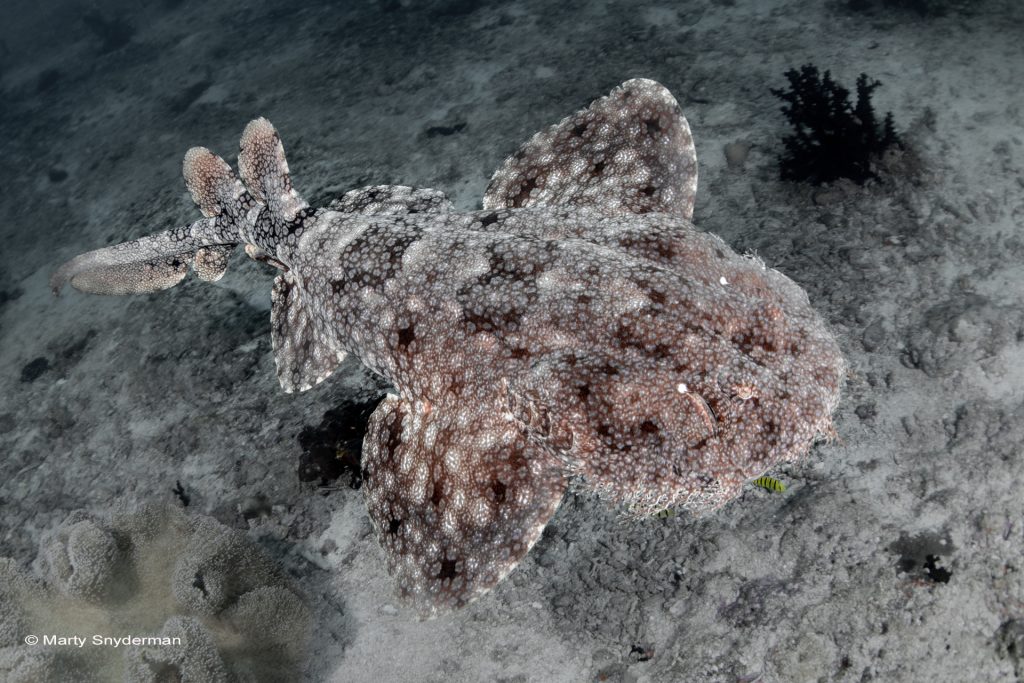
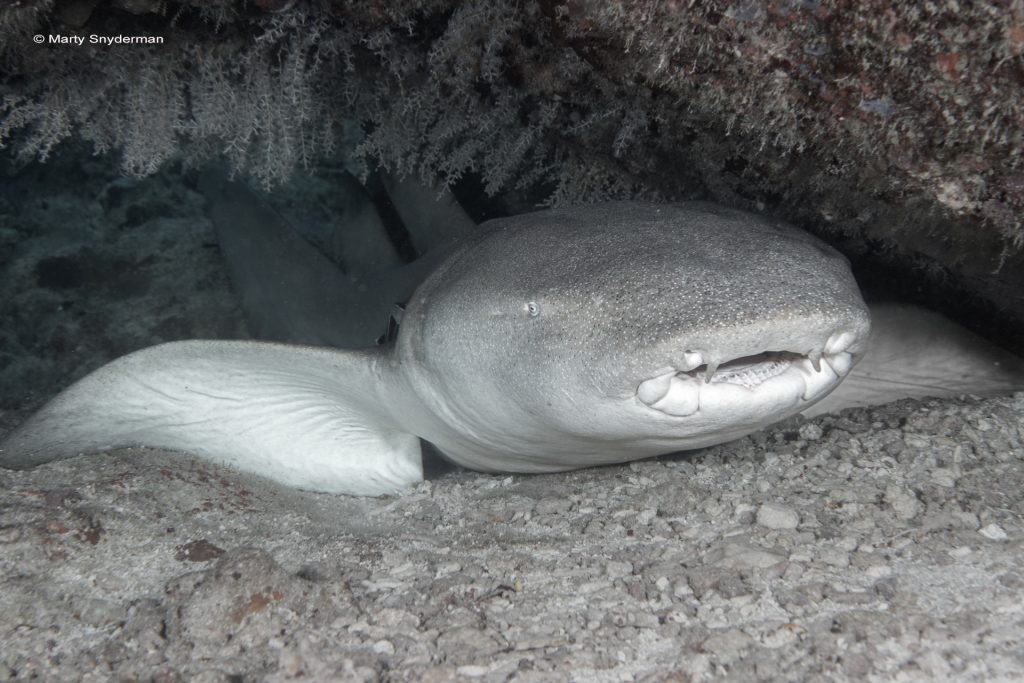
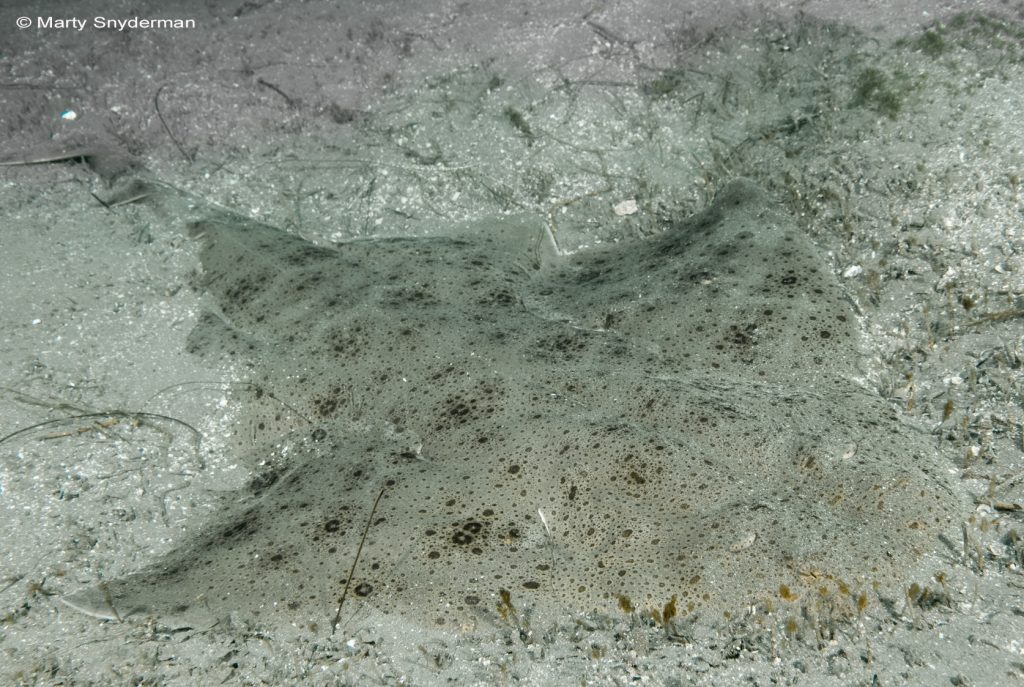
While they are certainly not the biggest sharks, getting overconfident and underestimating the injuries that can result from the bites of angelsharks, wobbegongs, nurse sharks, and other seemingly lethargic, docile species has resulted in numerous regrettable incidents.
Don’t be lulled into complacency and overconfidence by the docile appearance of sharks like the Pacific angelshark, tassled wobbegong, and tawny nurse shark seen here.
Countering Countershading
One of the photographic challenges presented by many sharks, manta rays, and other species that inhabit the open sea or that live in the water column is their countershading. The upper portion of their body is darkly hued, and the underside is whitish. Countershading allows these species to more easily blend with their surroundings, whether they are seen from above or below.
Countershading also makes it easy for underwater photographers to overexpose lightly hued faces and the undersides of bodies when using a strobe. When shooting with a strobe(s), I find it beneficial to use a TTL exposure option set to slightly underexpose my subject, thus preventing the whitish body parts from being badly overexposed. If necessary, you can increase the exposure using post-capture software.


A big advantage of TTL exposure systems can be experienced when countershaded animals are swimming toward you and pass over your head or just off to your side. When using a strobe(s) in a manual mode in those instances, it is virtually impossible to adjust your strobe power fast enough to acquire one proper exposure after another by compensating for the change in distance between your strobe and subject. However, a TTL system can make the adjustments in real time, thus providing a series of frames with a properly exposed subject. That’s a significant advantage!
If using a camera system that does not offer TTL, consider reducing your strobe power to avoid over exposure.
Great Barracudas
On night dives, some animals use divers’ lights to help them find prey. In some scenarios, this can help photographers capture predation. However, in the cases of great barracuda and some other nocturnal predators, this can mean having a fast-moving predator hitting prey immediately in front of or around you. I have aborted two dives after getting brushed uncomfortably hard by a barracuda that was feeding in the beam of my light. I felt the impact and saw a blur and fish scales. I was aware of similar instances in which divers have been bitten, so I aborted the dive.
There is no shame in that. One of the fundamental guidelines of safe diving is to stay within your comfort zone. No image is worth getting hurt for and diving should be fun.
A Final Thought
In my opinion, diving around and photographing big marine animals can be extraordinarily rewarding experiences. Images from those encounters are held in high regard and the memories are lifetime treasures. Regarding safety, at some point you must draw your own lines. I hope that when you do, you will think safety first and always so you can get the most out of your encounters with Mr. Big.