NAUI Affiliates Collaborate on Cavern Diver and Ecosystem Training in Mexico
In February 2026, NAUI divers will have the opportunity to participate in a unique educational diving program in Mexico’s Yucatán Peninsula that blends advanced overhead environment training with in-depth ecosystem education. Taking place February 5–15, 2026, this international collaboration brings together NAUI affiliates from Europe and North America to deliver a structured learning experience that goes well beyond recreational diving.

A Global NAUI Partnership
This event is organized by a certified diving group from the Czech Republic operating under the AMERS DIVE educational platform (NAUI #PE52010), which has been part of the NAUI community since 2010. The program is delivered in cooperation with Buceo Xtabay (NAUI #PE16728), a NAUI dive center located in Puerto Morelos, Mexico.
By combining international instructional experience with local knowledge of the region, the event highlights the strength of NAUI’s global affiliate network and demonstrates how cooperation across borders can elevate diver education and environmental awareness.
Cavern Diver Training in an Overhead Environment
At the core of the program is the NAUI Cavern Diver course, an overhead environment diving course designed to develop the skills, awareness, and discipline required for diving beneath a physical ceiling. Cavern training introduces divers to essential overhead protocols while remaining within defined limits that emphasize safety and situational control.
The NAUI Cavern Diver course can be taken prior to NAUI’s Intro to Technical Diving course, making it an important step for divers interested in expanding their training beyond open water environments. By completing cavern training first, divers gain valuable experience in dive planning, buoyancy control, communication, and emergency procedures specific to overhead settings before progressing into more complex technical disciplines.
Understanding Cavern Diving versus Cave Diving
A key educational component of the program is a clear understanding of the distinction between cavern and cave environments, a foundational concept in overhead diving.
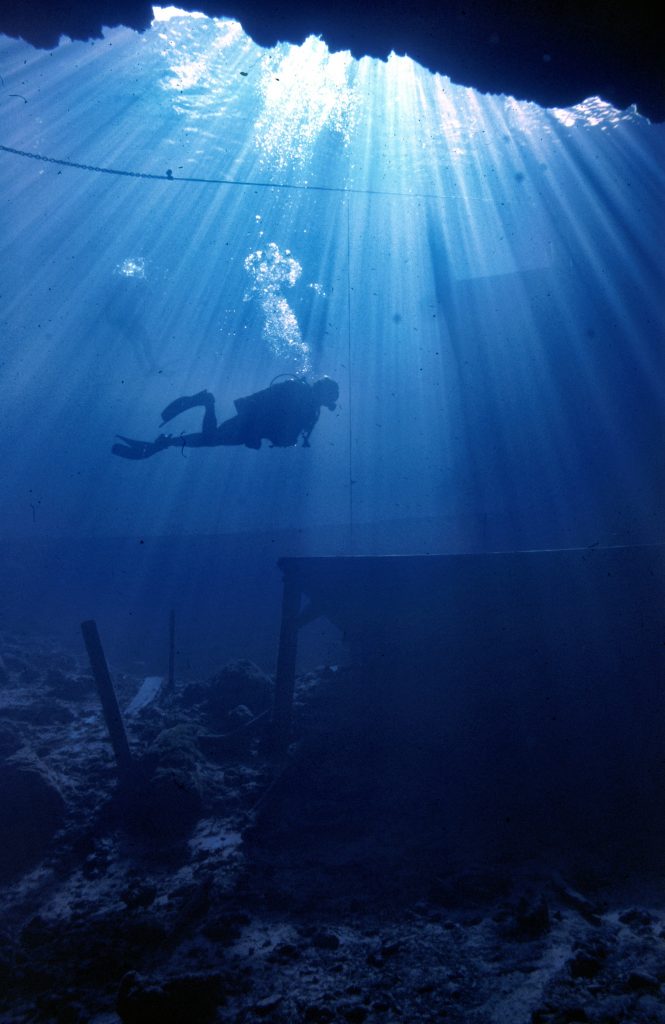
A cavern is defined as an overhead environment where natural light is always visible within the passage space, providing a visual reference to the exit. This natural light plays a critical role in how cavern dives are planned and conducted. However, conditions matter. A cavern dive conducted at night would no longer meet the definition of a cavern, as the absence of visible natural light effectively changes the environment into a cave setting.
A cave, by contrast, is an overhead environment where no natural light can be seen at any point. These environments require higher levels of training, redundancy, and planning due to the complete loss of a direct visual reference to the surface.

By addressing these distinctions in both academic and practical settings, the program reinforces NAUI’s emphasis on appropriate training, environmental awareness, and making informed decisions based on conditions, not just location.
Ecosystem Education in the Yucatán
What sets this event apart is its strong focus on environmental education alongside technical skill development. Academic sessions will take place in Puerto Morelos and are designed to help divers understand how the region’s underground cave systems, freshwater cenotes, and coastal marine environments are interconnected.
The Yucatán Peninsula is globally known for its extensive cenote systems and the critical role they play in water movement and ecosystem health. Through expert commentary and guided exploration, participants will gain insight into how geology, hydrology, and marine ecosystems influence one another, fostering a deeper appreciation for the environments in which they dive.
Advancing NAUI’s Mission Through Education and Collaboration

This program reflects NAUI’s commitment to dive safety through education by integrating hands-on training with broader environmental and geographical understanding. It also serves as a real-world example of how NAUI affiliates can collaborate internationally to create meaningful, high-quality educational experiences.
By combining cavern diver training with ecosystem-focused learning, this event demonstrates how NAUI programs can prepare divers not only to dive safely in overhead environments but also to become more informed, responsible divers.